Rhetorical Innovation with AI Integration: A Guide to Finding Your Most Authentic and Engaging Voice, Together with AI is a peer-reviewed writing and rhetoric textbook by Nicole Hospital-Medina, Writing Lecturer at the University of Miami. Published by Cognella Academic Publishing in 2025, the book helps students develop authentic voice, rhetorical agency, self-awareness, and confidence while learning to use generative AI intentionally in their writing.
What makes this book different?
Rather than beginning with AI, Rhetorical Innovation with AI Integration begins with the student.
The book asks students to consider: What do I value? What are my goals? What do I want to say? What kind of writer do I want to become? How do I use AI to help MY writing?
From there, students learn to make intentional decisions about when and how AI can support their writing without replacing their ideas, voice, creativity, or rhetorical judgment.
Request a FREE Digital Review Copy here!
My book, Rhetorical Innovation with AI Integration, addresses the intersection of rhetorical skills and artificial intelligence (AI), focusing on authenticity in the age of digital assistants. This peer-reviewed book emphasizes the importance of one’s unique voice and perspective in writing, arguing that while AI can enhance and amplify an individual’s expression, it should never overshadow the human element that makes communication engaging and meaningful.
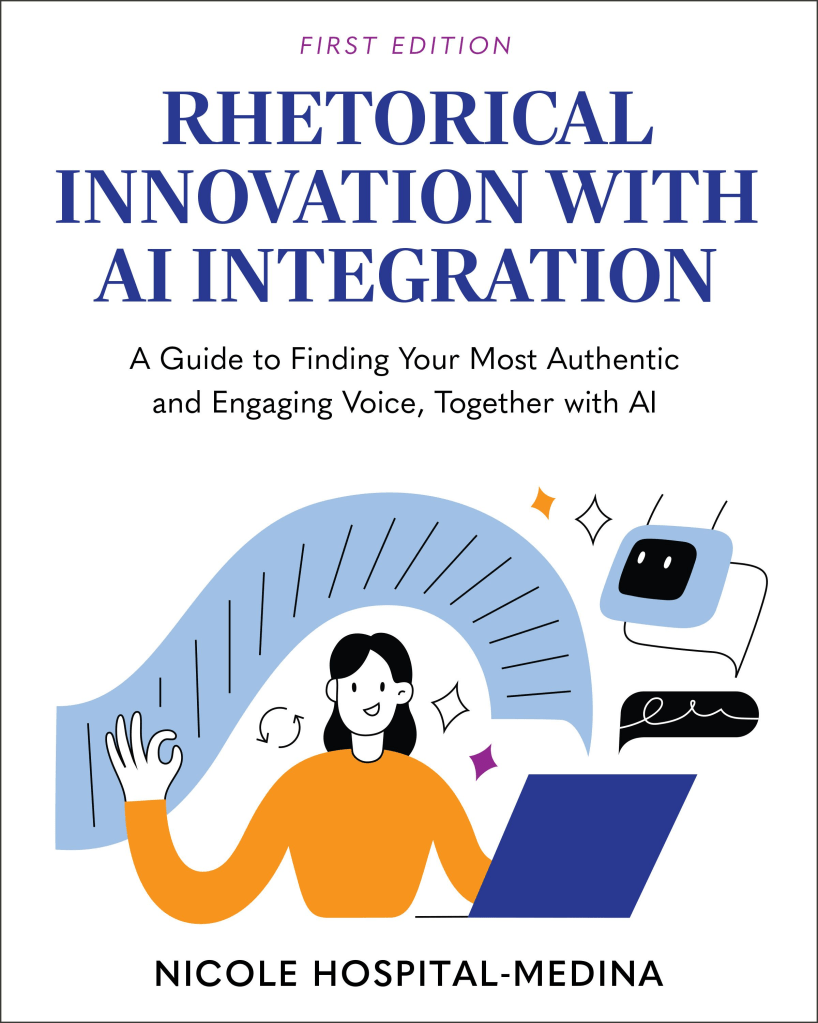
The content spans a variety of topics such as the cultivation of good ideas, understanding reader engagement, and the role of creativity in both AI-assisted and independent writing endeavors. It delves into the usefulness and structures of writing through traditional and non-traditional forms, while considering organizational strategies and the limitations of AI in capturing human experience and thought.
Rhetorical Innovation with AI Integration helps students enhance their authentic voice and perspectives with AI. The book equips readers with strategies to successfully balance technological assistance and personal storytelling, laying the groundwork for enhancing written communication without losing authenticity.
PERFECT for classes such as:
First-Year Writing, Composition Rhetoric, English Composition, Communications, Multimodal Writing, AI and Writing, Writing Across the Curriculum, Writing with Generative AI, Content Development
Adoption of the book includes: Chapter presentations, a 16 week syllabus, low stakes writing exercises and major assignments.
Instructors are using Rhetorical Innovation with AI Integration to help students explore their values, goals, authentic voice, and intentional use of AI in writing.
Request a FREE Digital Review Copy here!
Professor Reviews:
“’This book is about you.’ From this very first line, Nicole Hospital-Medina draws us into a deeply human exploration of writing with AI. She reminds us that our individual life stories and perspectives shape a voice no technology can replicate and that the world needs to hear. With real-life examples that range from sculpture to sports, she guides us through the creative process. Her writing is genuine and approachable, connecting with readers through the authenticity of her experiences. As an English major, and now, Educational Technology faculty, this book is now a trusted companion I’m sharing with students, faculty, and friends across different industries.”
Maria Elena Corbeil, Ed. D., Professor of Educational Technology
“With Rhetorical Innovation with AI Integration, Nicole Hospital-Medina has given us a textbook that truly centers around the student writer’s unique voice. While guiding us through ethical and creative uses of AI in the writing classroom through thoughtful and engaging writing and activities, the book never loses sight of its true mission: to show that AI does not have to be the road towards uniformity but can be an opportunity to discover, encourage, and celebrate student expression and authenticity.”
Claudia Hoffman, Ph. D., Lecturer, Writing Studies Department, University of Miami
Student Reviews:
“I liked how this book made you think in ways that are beneficial toward any writing project and can be applied in future classes.”
“What appealed to me about the book is the first person tone, it made the chapters less boring and I was able to engage more.”
“I really liked this book and I felt it was very different than any other textbook I have read. I almost felt really connected to this book because it related very well to what we are doing in class or I can read the book to know what we will doing in class.”
“I like the brevity and forwardness.”
Request a FREE Digital Review Copy here!

